

PON fibre optic systems

PON Network Components
A passive optical network consists of the following main elements:
| Component | Purpose |
|---|---|
| OLT (Optical Line Terminal) | Central device or head station. Controls all subscriber devices and forms data flows from the node to subscribers |
| Optical splitter (PLC) | A passive element of optical networks. Distributes the signal from the OLT to several ONUs. Does not require power supply |
| ONU/ONT (Optical Network Unit / Terminal) | A subscriber device designed to connect subscribers to the Internet |
| Optical cable | Connects OLT, splitter and ONU into a single infrastructure |
PON Standards and Speeds
| Standard | Downstream/upstream speed | Max. number of subscribers | Max. distance |
|---|---|---|---|
| GPON (G.984) | 2.5 Gbps / 1.25 Gbps | 64 / port | up to 20 km |
| XG-PON (G.987) | 10 Gbps / 2.5 Gbps | 128 / port | up to 20 km |
| XGS-PON (G.9807.1) | 10 Gbps / 10 Gbps | 128 / port | up to 20 km |
| NG-PON2 (G.989)* | up to 40 Gbps / up to 10 Gbps | up to 256 | up to 40 km |
Note*:
 Speed: NG-PON2 uses TWDM (Time and Wavelength Division Multiplexing) and can reach up to 40 Gbps downstream (4 x 10 Gbps) with the possibility of up to 10 Gbps upstream depending on configuration.
 Speed: NG-PON2 uses TWDM (Time and Wavelength Division Multiplexing) and can reach up to 40 Gbps downstream (4 x 10 Gbps) with the possibility of up to 10 Gbps upstream depending on configuration.
 Max. Subscribers: Up to 256 subscribers – possible if multiple wavelengths and ports are used, but typical configuration is up to 128 per port with 4-8 λ.
 Max. Subscribers: Up to 256 subscribers – possible if multiple wavelengths and ports are used, but typical configuration is up to 128 per port with 4-8 λ.
 Max. Distance: Up to 40 km is the maximum range for NG-PON2 with appropriate amplifiers.
 Max. Distance: Up to 40 km is the maximum range for NG-PON2 with appropriate amplifiers.
All the above standards imply the use of passive optical splitters with a distribution ratio from 1:2 to 1:64, which affects the actual number of subscribers and the range. For NG-PON2, a range of 40 km is achieved with EDFA (Erbium-Doped Fiber Amplifier).
Types of subscriber terminals ONU/ONT
We offer compact and functional ONU devices that ensure stable operation in PON networks, including GPON, XGPON and XGSPON.
| Model | PON standard | Ports | Wi‑Fi | Protocols | Peculiarities |
|---|---|---|---|---|---|
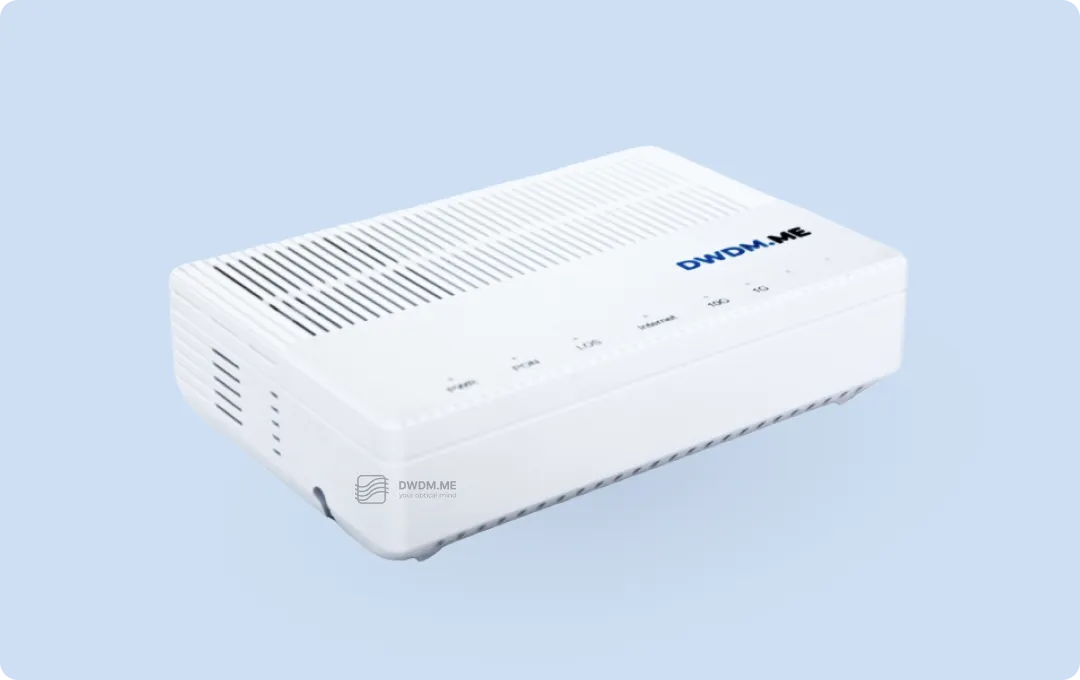
| XGP‑1+2.5 | GPON | 1x GE | No | VLAN, QoS | Compact, wall mounted |
| XGSP‑1+10 | XGS‑PON | 1x10GE | No | 802.1Q, TR‑069 | Increased throughput |
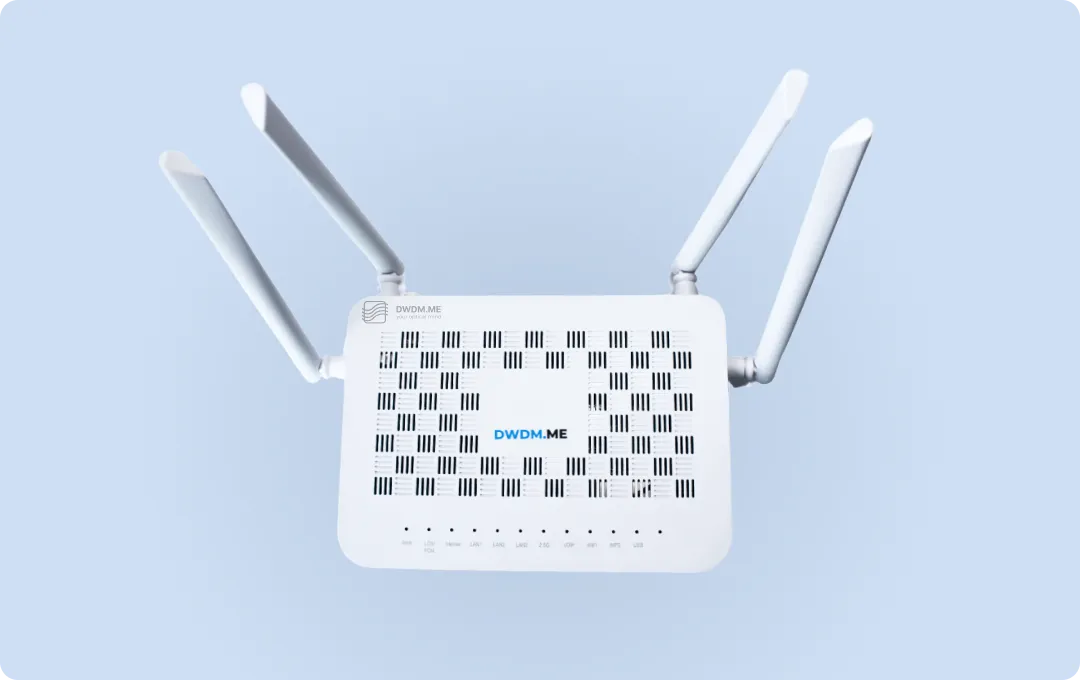
| XGPWF‑6 | GPON | 4x GE, 2x FXS | Yes (dual band:2.4 GHz and 5 GHz) | VoIP, SNMP | Telephony support |
| XGSPWF‑6VC | XGS‑PON | 4x GE, 2x FXS, USB | Yes (802.11ac) | IPTV, ACL | Built-in router |
| SFP‑ONU‑X / XS | GPON/XGS‑PON | SFP | No | – | Installed in a switch or router |
OLT equipment
OLT equipmentOptical network terminals (ONT/ONU) are the last link in this chain and provide end users with access to the Internet, television and telephony. On the operator side, there is an optical line terminal (OLT), which manages the distribution of signals across the network.
Available functions:
-
support GPON/XGSPON/NG‑PON2;
-
 up to 16 PON ports;
 -
uplink via 10GE/40GE;
-
 management via CLI, WEB, SNMP;
 -
 possibility of controller redundancy.
 support GPON/XGSPON/NG‑PON2;
 up to 16 PON ports;
 management via CLI, WEB, SNMP;
 possibility of controller redundancy.
Modern standards such as XGS-PON support speeds up to 10 Gbps downstream and 10 Gbps upstream and provide a sustainable foundation for network growth, meeting the needs of operators, businesses and residential users.

 FTTH (Home Internet) Providers
 Connecting residential complexes and office buildings
 Internal networks of enterprises and campuses
 Video surveillance networks
 Distributed IT infrastructure
Examples of PON equipment
-
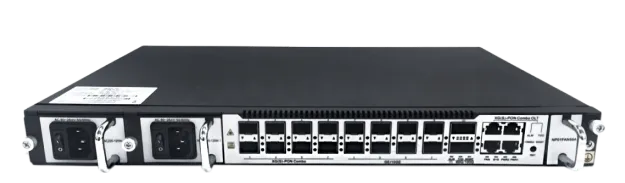
LT6320X XG(S)-PON Combo OLToptical line terminal
The LT6320X OLT is a compact 1U device compliant with ITU-T G.987/G.988 standards that supports simultaneous G, XG and XGS-PON operation. It provides high-speed Internet access, voice services and video surveillance in a variety of network architectures, including FTTH, VPN, and campus networks. The device supports a mixed network with different ONUs and is GPON compatible, allowing for easy network upgrades without replacing existing equipment. -
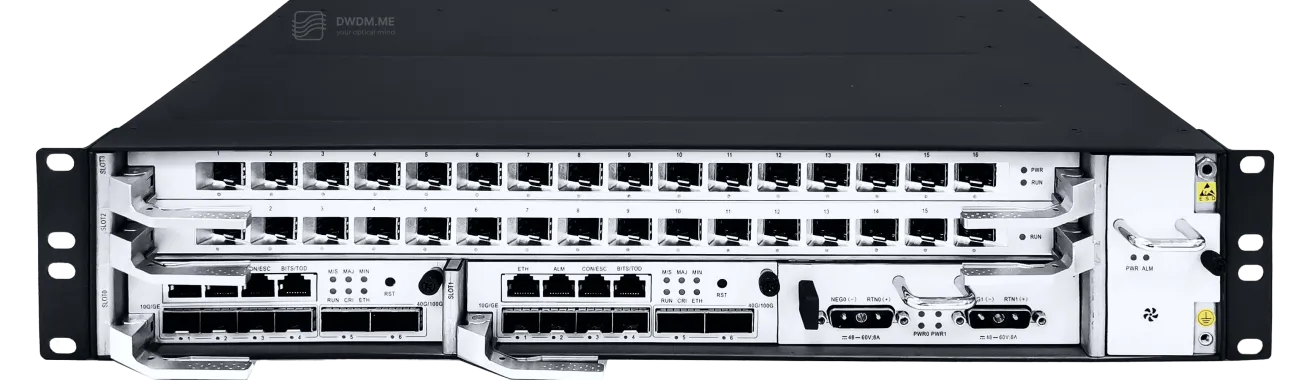
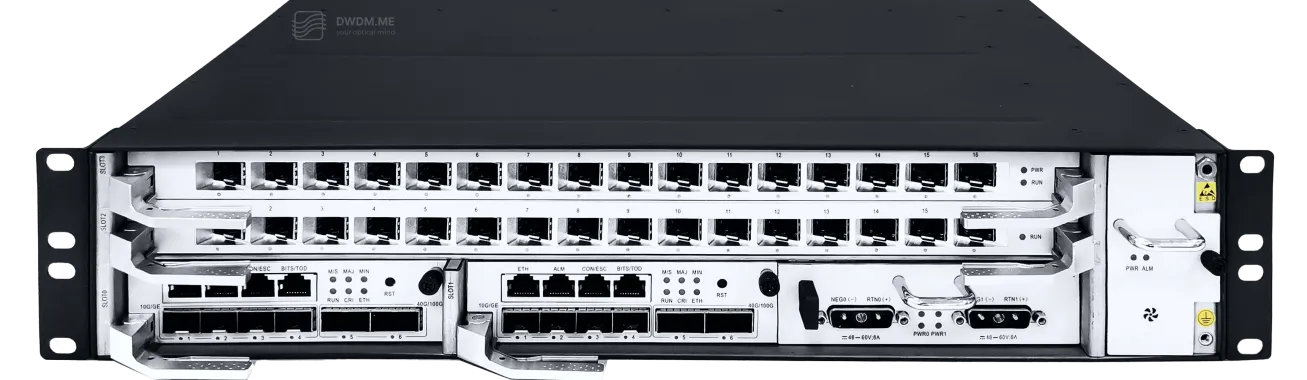
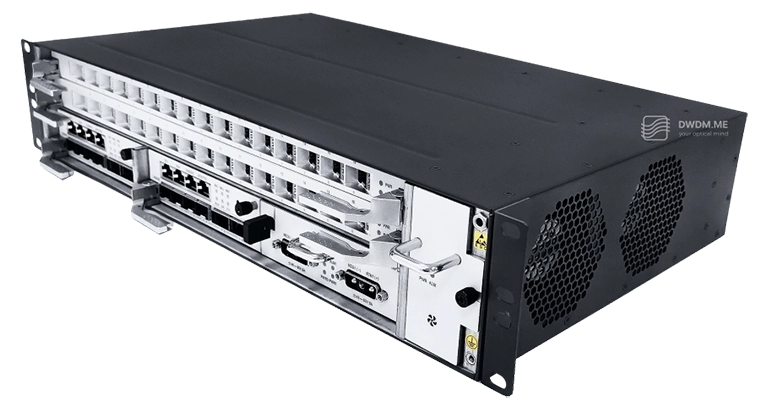
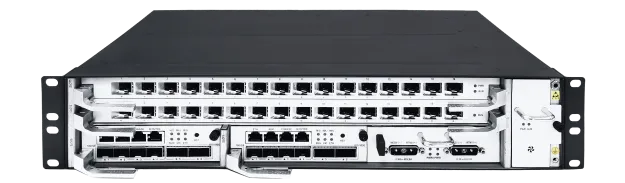
LT7310X-32 XG(S)-PON 2U 10G OLTOptical Line Termina
The LT7310X-32 is a high capacity device for operators and ISPs that supports integrated access via GPON/XG-PON/XGS-PON. Equipped with two management slots and two card slots, it offers up to 32 GPON ports and 32 XG(S)-PON ports, allowing up to 128 ONUs per port. The device also features four GE/10GE SFP+ interfaces and two 100G QSFP28 ports for high-speed connectivity. With its compact 2U design, the LT7310X-32 optimises space utilisation, providing flexibility and cost-effective operation




Why buy PON equipment from DWDM.ME
Our company offers a wide range of equipment for building PON networks, including optical splitters, subscriber terminals and backbone components. The catalog also includes DWDM equipment: transceivers, amplifiers, multiplexers and solutions for increasing the signal transmission range. All devices are provided with warranty and post-warranty service, and our specialists are always ready to help with the selection of the optimal solution for specific tasks.
Examples of optical network terminals
-
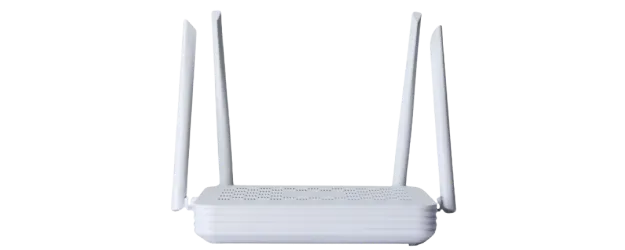
XGPON XGPWF-6 Optical Network Terminal
XGPON optical network terminal (AX3000 Mbps), provides basic Wi-Fi, routing and Gigabit Ethernet functions. Designed for telecom operators, it provides ultra-broadband access using XGPON upstream technology. It can also be used as a multi-service access and control centre for the home, providing users with high-speed Internet access, voice call services and WiFi. -
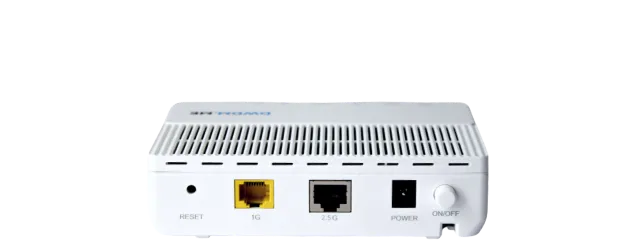
XGPON XGP-1+2.5Optical Network Terminal
The device supports access via XGPON upstream technology, providing a reliable and high-speed connection. The optical terminal offers users a wide range of Ethernet functions for efficient network management. Equipped with XGPON ports to handle upstream traffic and includes 2.5GE and GE electrical ports to connect various devices and provide flexibility in network configuration.
Product Gallery