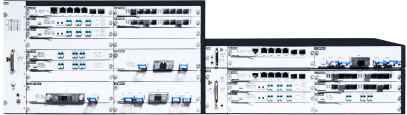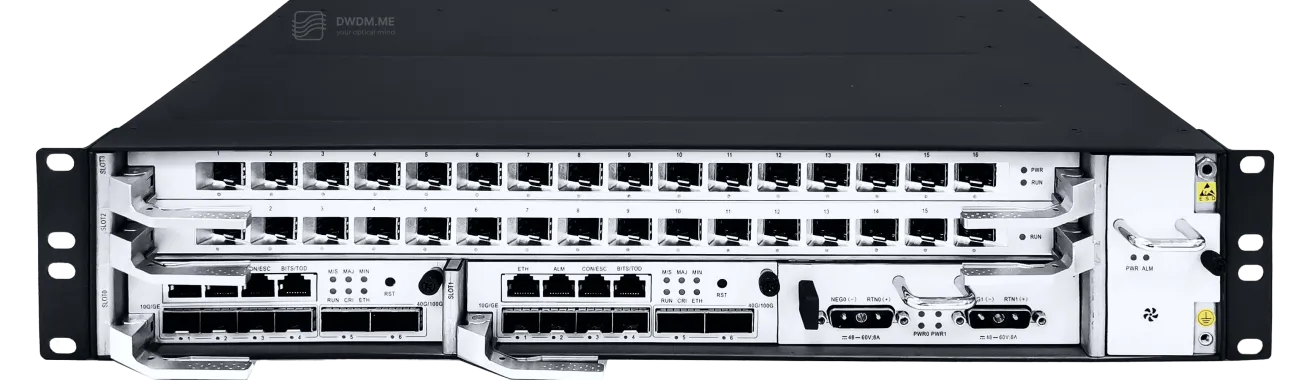


EDFA optical amplifier board


Main types of EDFA
 Booster EDFA – installed immediately after the transmitter, increases the signal power before entering the transmission line (output power 13-24 dBm).
 Line EDFA (linear) – used in the middle of the route to compensate for signal attenuation (attenuation 10-20 dB).
 Pre-amplifier EDFA – amplifies a weak signal before the receiver (sensitivity ~-30 dBm).
- Dual EDFA (double) – combines the functions of a preamplifier and a booster.
 Middle Stage Access (MSA) – a variant with access to the middle point (for OADM – Optical Add-Drop Multiplexer).
 Single Fiber EDFA – supports transmission and reception over one fiber.
 Booster EDFA – installed immediately after the transmitter, increases the signal power before entering the transmission line (output power 13-24 dBm).
 Line EDFA (linear) – used in the middle of the route to compensate for signal attenuation (attenuation 10-20 dB).
 Pre-amplifier EDFA – amplifies a weak signal before the receiver (sensitivity ~-30 dBm).
 Dual EDFA (double) – combines the functions of a preamplifier and a booster.
 Middle Stage Access (MSA) – a variant with access to the middle point (for OADM – Optical Add-Drop Multiplexer).
 Single Fiber EDFA – supports transmission and reception over one fiber.
Technical specifications
| Parameter | Value |
|---|---|
| Wavelength range | 1528–1565 nm (C-band) |
| Output power/gain | 13–24 dBm / 8–35 dB |
| Gain (Line EDFA) | up to 35 dB |
| Gain plane | < 1 dB |
| Noise level (NF) | < 5 dB |
| Control modes | AGC, APC, ACC (Automatic Gain Control, Power Control, Current Control) |
| OSC (Optical Supervisory Channel) support | Yes |
| Monitoring support | Yes (SNMP/WEB GUI/CLI) |
| Interfaces | SC/UPC, LC/UPC, SC/APC, etc. |
| Power | 220 V / -48 V |
| Temperature range | 0 … +50 °C (for outdoor use it can be -40 … +70 °C) |
Advantages of EDFA
-
Does not require conversion of optical signal into electrical signal
-
Low noise level (< 5 dB)
-
High output power (up to 24 dBm)
-
Compatible with DWDM (C-band)
-
 Support all control modes
 -
Compatibility with Cisco, Huawei, Juniper and other equipment thanks to MSA standards
-
 Easy to integrate into your existing network
 Does not require conversion of optical signal into electrical signal
 Low noise level (< 5 dB)
 High output power (up to 24 dBm)
 Compatible with DWDM (C-band)
 Support all control modes
 Compatibility with Cisco, Huawei, Juniper and other equipment thanks to MSA standards
 Easy to integrate into your existing network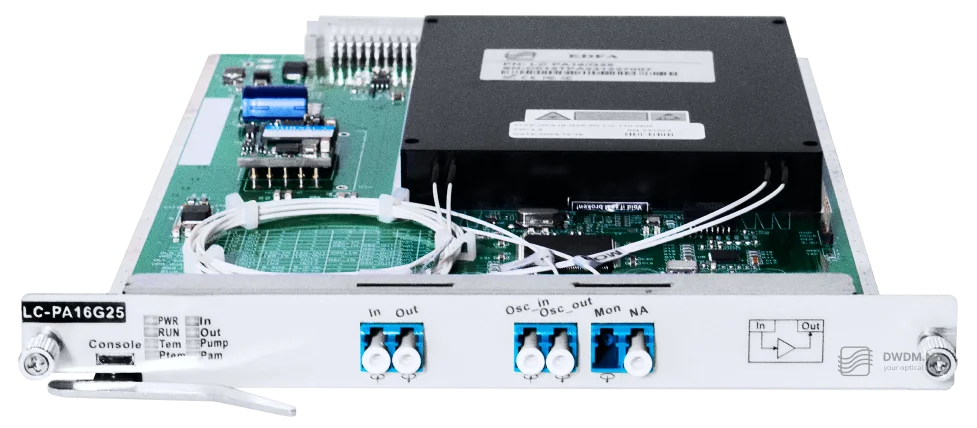

Where is the technology applied
DWDM EDFAs, often in combination with other equipment including optical transceivers, are used in telecommunications and data communications applications.
-
Fiber-optic trunk and regional communication lines
-
Data processing centers (DPC)
-
 Long Range CCTV Systems
 -
Multimedia and broadcasting networks
-
Underwater and intercity communication lines
 Fiber-optic trunk and regional communication lines
 Data processing centers (DPC)
 Long Range CCTV Systems
Due to their reliability and high efficiency, EDFA amplifiers have become indispensable as they provide stable signal transmission over long distances.
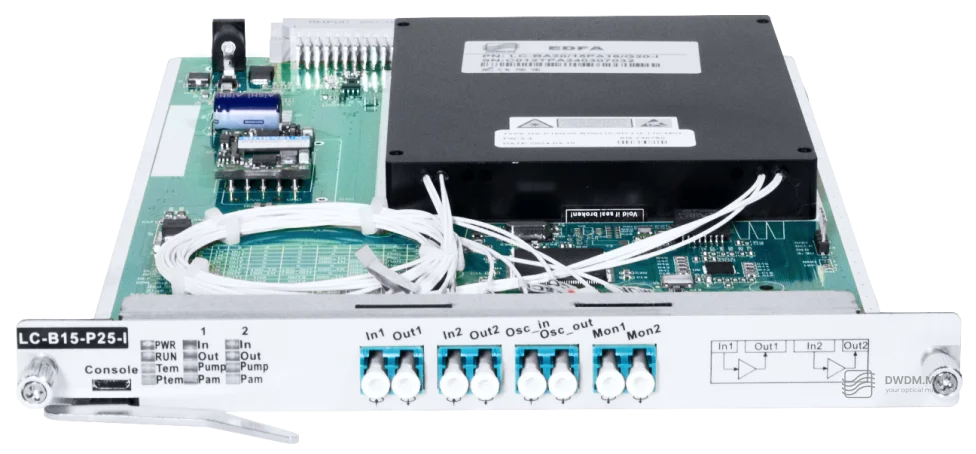

How to choose EDFA amplifier
The selection of an EDFA amplifier should be based on a number of factors:
-
Where will the amplifier be installed? (start/middle/end of the route)
-
What is the required output power?
-
Is OSC or monitoring supported?
-
Single or double fiber?
-
What are the requirements for noise level and gain plane?
-
 Is there a temperature/power limit?
 Is there a temperature/power limit?
Careful analysis of these parameters will allow you to select the optimal amplifier model for a specific application, taking into account the operating conditions and project goals.


Product Gallery
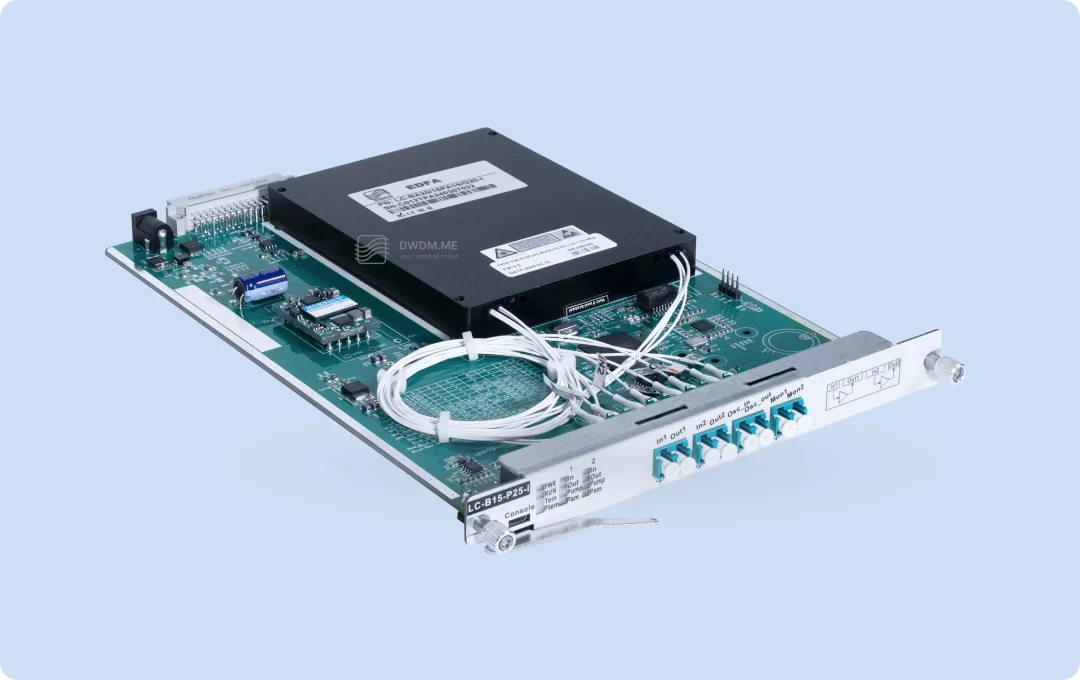
Dual EDFA Optical Amplifier
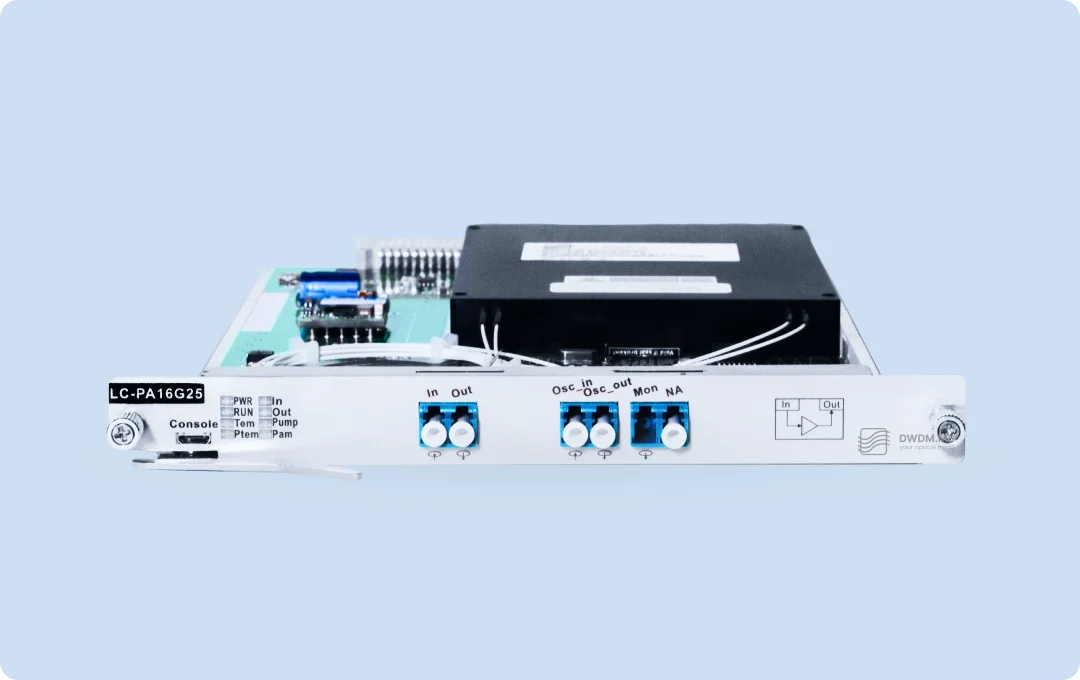
EDFA Optical Amplifier
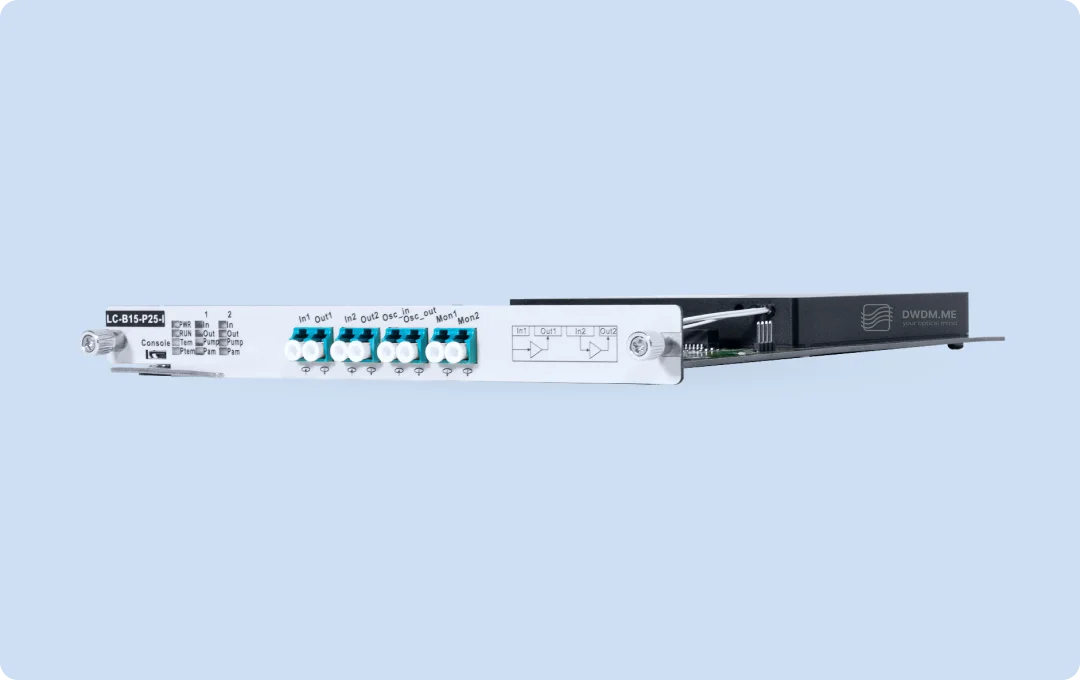
Dual EDFA Optical Amplifier