
 20.03.2025
 17772
17772 The advancement of technology and the growing volume of transmitted data increase the requirements for communication quality. The speed of signal transmission through optical fiber plays a crucial role: even minor delays can reduce the performance of communication systems. This is especially critical for processes where timely transmission and data synchronization are essential. Therefore, it is important to understand how attenuation in an optical cable is calculated.
What is Optical Fiber Delay?
Temporal delays or latency in optical fiber refer to the time it takes for a light signal to travel a certain distance from the source to the receiver. Despite the high data transmission speed, the signal does not propagate instantly and requires time to cover the distance. When transmitting over long distances, the delay can become noticeable.
Delay is measured in microseconds (µs) or nanoseconds (ns). In high-speed networks, data centers, financial systems, and other critical applications, even slight signal attenuation can cause technical failures or financial losses.

Speed of Light in Optical Fiber and Refractive Index (IOR)
In a vacuum, the speed of light is 299,792 km/s. However, outside of a vacuum, this value decreases. The speed of light in optical fiber is lower due to the Index of Refraction (IOR) of the fiber material. This index indicates how much slower the speed will be compared to a vacuum. For standard quartz optical fiber, the refractive index is typically around 1.468.
The actual speed is calculated using a specific formula. For example, with a standard refractive index, the speed of light in fiber will be 204,000 km/s.
How to Calculate Optical Fiber Delay
The calculation of optical cable attenuation is straightforward. The following formula is used:
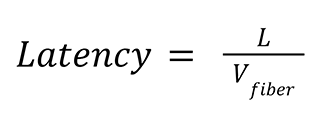
where:
Latency – signal delay (seconds);
L – length of the optical fiber cable (km);
Vfiber — speed of light in optical fiber (km/s).
Let’s look at an example to understand the calculation. Consider a cable 100 km long with an optical fiber refractive index of 1.468.
First, we calculate the speed of light in the fiber:

Now, we calculate the signal delay:

Thus, the signal delay for a 100 km cable is 490 microseconds.
Key Factors Affecting Optical Fiber Delay
Signal delay is determined by several factors. The key factors include:
- Refractive index – a higher index results in a lower signal speed.
- Type of optical fiber – single-mode fibers have lower latency compared to multimode fibers because the signal travels in a straighter path.
- Cable routing and length – each additional kilometer increases delay. A direct cable path is preferable to a complex route with bends and joints.
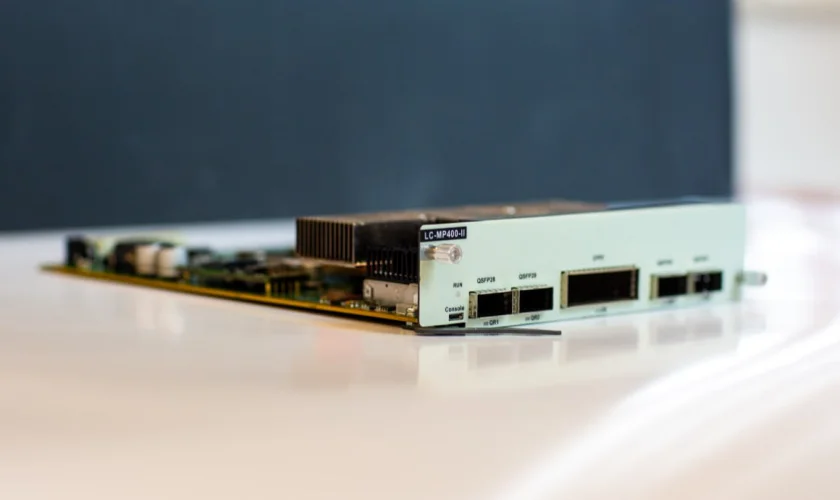
- Network equipment, DWDM devices, and converters – every piece of equipment (such as routers, media converters, and switches) increases delay.
If minimizing signal delay is critical, all these factors must be considered. Determine whether optical transceivers are necessary or if prioritizing fiber speed is more beneficial. This will help in selecting the most optimal solution.
How to Reduce Signal Delay in Optical Fiber
There are several solutions to minimize signal delay in an optical fiber network:
- Choose single-mode fiber – it has the lowest signal attenuation, resulting in higher speed.
- Reduce cable route length – a shorter cable reduces delay. It is also preferable to lay cables in a straight path to avoid bends that cause signal attenuation.
- Select fiber with a lower refractive index – some modern optical fibers have improved characteristics, allowing for higher speeds.
- Minimize intermediate equipment – fewer intermediate devices mean lower overall delay. If delay reduction is crucial, avoid unnecessary network equipment, keeping only essential components like EDFA optical amplifiers.
- Use high-quality components and proper installation – follow installation technology, use high-quality equipment, and avoid excessive splicing.
Following these recommendations will help minimize signal delay in an optical network, improving performance, reliability, and overall network efficiency.