
 06.11.2025
 1666
1666 In today’s world, 10G bandwidth is no longer sufficient. Constant traffic growth and the development of PON networks are forcing us to move to new speeds. That is why operators and data centres are implementing 100G or 400G. But it is not that easy to do. You need to think through the architecture in advance and install the appropriate DWDM equipment.
In this article, we will discuss what is needed to connect high-speed channels. We will also examine the pitfalls and how to avoid them.
What is needed to connect 100G and 400G channels via DWDM
To connect 100G or 400G channels, it is not enough to simply replace the optical module. Many details must be taken into account, including line length, equipment characteristics, and attenuation levels.
To do this, the following are used:
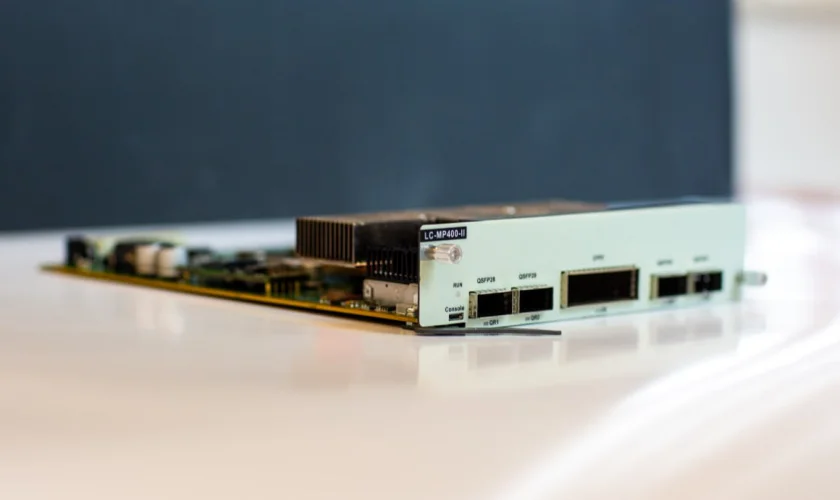
DWDM equipment – supports 100G and 400G modules;
mappers or transponders – route customer traffic to the DWDM format;
multiplexers and demultiplexers – combine multiple channels into a single optical line;
EDFA amplifiers – compensate for signal attenuation over long distances;
monitoring and control system – tracks line parameters in real time.
Connecting 100G or 400G channels is a whole chain of coordinated actions. Everything depends on the specifics. For example, for a telecommunications operator, the main challenge is distance, especially when building trunk lines between cities. Therefore, it is important to calculate the budget correctly and use amplifiers.
For corporate networks, the main focus is on reliability and simplicity. Speed is secondary. That is why hybrid schemes are used as a basis. In them, one part of the channels is transferred to 10G, and the other to 100G.
For data centres, the emphasis is on low latency and high channel density. This is because every millisecond and every unit is expensive.
Advantages of connecting via DWDM
Among the main advantages are:
Optical savings. More than a dozen channels are transmitted over a single fibre pair. Therefore, there is no need to rent or lay additional cables. This significantly saves money. For example, in a city, fibre optic rental can cost thousands of pounds per month. With a DWDM connection, the bandwidth of a single cable increases tenfold.
Scalability. Expanding the number of channels is simple – just add new modules. All this takes a matter of hours. For example, today you have 4 or 8 channels, and tomorrow you can expand to 40 or 80.
Flexibility. Different speeds can be mixed in one system – from 10G to 400G. This is especially relevant if the network was built in stages. For example, if a provider has a 40-channel DWDM backbone. Let’s say 30 channels are occupied by 10G, another 5 by 100G, and 2 by 400G. The remaining 3 channels are reserved for growth. And all this works on a single cable.
Long-distance support. With the help of EDFA amplifiers, DWDM allows signals to be transmitted over hundreds of kilometres. At the same time, the quality remains unchanged.
Compatibility with existing infrastructure. DWDM equipment can be implemented gradually, while retaining old lines. This does not require a complete network rebuild.
In essence, DWDM is an optical switch. With its help, you can rationally use fibre resources and raise channels of any power.
Requirements for 100G/400G transmission equipment
The equipment must meet several criteria:
Support high-speed modules. QSFP28 or CFP formats are most commonly used for 100G. For 400G, QSFP-DD or CFP2-DCO are used.
Provide a stable signal. At such speeds, even small noises or synchronisation errors lead to failures. Therefore, precise tuning is important.
Have low latency. For data centres, it is critical that the addition of a DWDM layer does not increase latency – the time required to transfer data from the source to the recipient.
Be flexible in working with different protocols. The network must be able to ‘digest’ Ethernet, OTN, and other standards.
Work with EDFA amplifiers. This is a mandatory element on long lines. It helps to avoid attenuation, and the equipment must support it correctly.
Important! The most common mistake here is the use of old multiplexers and filters that are designed, for example, for only 10G. Of course, the signal will pass, but at 100G it will be significantly distorted. Therefore, when upgrading and scaling the network, it is important to check the compatibility of each element.
You should also give preference to proven brands. It is better to overpay at the beginning, when you are just creating or upgrading your network, and choose a proven solution that is certified for high speeds. If you buy a cheap ‘no-name’ product, the equipment will give an error at high speeds and high data transfer rates.
Use of transponders and mappers
Transponders and mappers are used to transform signals. These devices convert pulses from the client interface into a format that is more suitable for transmission over DWDM.
Transponders are used for several reasons:
to perform signal conversion, error correction, and transmission quality improvement functions;
to allow client devices to work directly with DWDM modules;
to provide a control point that allows each channel to be monitored without using client equipment.
Mappers also perform similar functions. But they are most often used for traffic aggregation. For example, when several 10G streams need to be combined into a single 100G channel. This method is often used by providers who are transitioning to new speeds.
If you plan to scale your network in the future, purchase transponders with upgradeability in advance. With their help, even if you are currently using a 100G network, you can switch to 400G in a day without completely changing your equipment.
The role of multiplexers and demultiplexers
Multiplexers are considered the heart of DWDM. This equipment combines several channels with different wavelengths into a single stream, which then travels along the fibre optic cable.
Demultiplexers work in the opposite way. They separate these channels at the output.
Both of these devices are important for the creation and proper operation of 100G or 400G networks. This is due to the high cost of each channel. This means that signal loss and transmission speed loss are unacceptable.
When choosing multiplexers, it is worth paying attention to several points:
Bandwidth. The more channels a multiplexer supports, the more flexible the network is.
Filter quality. This determines whether the channels will interfere with each other.
Compatibility with EDFA amplifiers. Sometimes, if the filters are incorrectly selected, they will ‘eat up’ part of the amplified signal.
Modern multiplexers are often presented in the form of MUX/DEMUX blocks, which are divided into 40, 48 or 96 channels. Usually, when creating regional networks, a minimum number is sufficient. But if you plan to build an entire backbone, it is better to choose equipment for 96 channels. This will be needed for scaling in the future, otherwise you will hit the ceiling in a few years.

Optical amplifiers and attenuation compensation
Fibre optics have one major problem: attenuation. The signal is lost with every kilometre. Therefore, the attenuation level depends on the wavelength. For single-mode fibre at 1550 nm, the loss is approximately 0.2 dB per kilometre. This means that over a distance of 100 km, the signal will weaken by approximately 20 dB. In addition to the fibre itself, connections also contribute to the loss:
connectors — 0.3–0.5 dB each;
splices — less, only 0.05–0.1 dB, but with a large number of joints, they also accumulate.
Considering speeds of 100G and 400G, the problem of signal attenuation becomes critical. EDFA fibre optic amplifiers are often used to solve this problem.
It works very simply. A section with erbium fibre is embedded in the optical fibre. When laser pumping is applied to it, the signal is amplified directly in optical form. It is not converted into electrical form. This is very cheap and effective. The signal can even reach distances of hundreds of kilometres.
In addition to classic EDFAs, Raman amplifiers are also used. However, these devices are much more expensive and difficult to configure. They produce less interference and allow lines to be extended further. Raman amplifiers are usually installed in trunk lines that are more than 600 km long.
Please note! An EDFA amplifier does not correct a poor signal. It only increases its power. If the line is already poorly installed or there is noise in it, the presence of an optical amplifier will not solve the problem. The cable must be checked first.
When connecting 100G or 400G, always allow for amplification reserve. If the loss is 20 dB, it is better to install a 25 dB amplifier.
Top mistakes when connecting 100G/400G DWDM networks
There are many pitfalls when connecting. Among the most common are:
Ignoring the optical budget. Often, everything is calculated approximately, and then the signal does not pass. Therefore, it is important to make an accurate calculation of the line in advance, taking into account all couplings, attenuations, connectors, and amplifiers.
Incorrect transponder settings. For example, the wrong choice of modulation or protocol mismatch can cause the channel to be unstable.
Using old DWDM equipment. Not all filters and multiplexers are designed for high speeds. Sometimes they physically ‘cut off’ part of the spectrum.
Saving on monitoring. If there is no management system, it is impossible to know about the problem until the channel goes down. This results in significant financial losses and customer complaints.
Poor fibre splicing. At speeds of 100G/400G, even minimal signal loss becomes critical.
Copying other people’s solutions without adapting them to your system. One scheme may work for your competitor. But it may not work for you: the line length is different, the fibres are older, and the activity is higher. Therefore, even if you take a ready-made solution as a basis, you always need to adapt it to your needs.
Connecting 100G and 400G via DWDM is not only about high speeds, but also about a competent approach. You need to correctly calculate the optical budget, select the equipment and install it.
At first, this seems very complicated. Everything must be planned competently and the characteristics of your network must be taken into account. But then the connection will be as reliable and cost-effective as possible. In the future, it will be possible to transfer significant amounts of data over long distances without laying new cables. That is why this technology is often used by providers and telecom operators. The 100G/400G format over DWDM is becoming the new standard.