
 12.06.2025
 278
278 A transceiver enables the construction or scaling of network infrastructure. However, selecting the wrong model can compromise connection quality. Here’s how to choose the right transceiver based on key factors like module type, form factor, and data transfer rate.
SR, FR, LR, ER, ZR - What's the Difference?
Transceivers are marked with designations like SR, FR, LR, ER, ZR, etc. These aren’t just letters-they indicate the module type, signal range over single-mode fiber, and other technical features.
| Type | Distance | Use Case |
|---|---|---|
| SR | up to 100 m (on MMF) | For short-range connections within a rack or between racks in the same room. Uses multimode fiber (e.g., OM3/OM4). Ideal for data centers. |
| FR | up to 2 km | Suitable for building-to-building or intra-campus connections. Also used for short-haul links. |
| LR | up to 10 km | One of the most popular types. Used for connecting network nodes and urban links. Compatible with single-mode fiber. |
| ER | up to 40 km | Suitable for remote and intercity links. Requires high-quality fiber and, in some cases, optical amplifiers. |
| ZR | up to 80 km | Designed for backbone and carrier-grade networks. Amplifiers are required. |
When selecting a module, consider the actual distance. For distances under 5-7 km, an LR module is usually sufficient-no need to overpay.
When to Use 100G and When 200G/400G Makes Sense
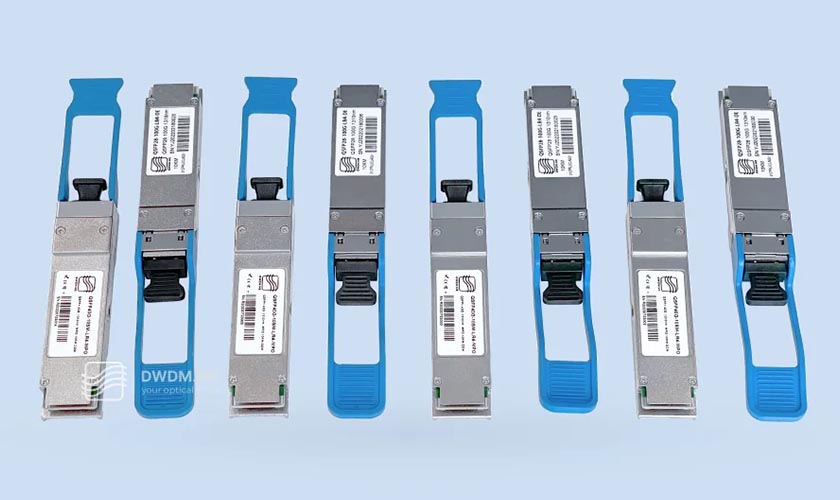
The 100G standard remains common in data centers and enterprise networks due to its reliability and wide compatibility.
However, 200G and 400G are gaining momentum in:
modern telecom operator networks;
spine-level infrastructure in data centers;
high-traffic core node connections;
cases requiring fewer modules and cables.
These high-speed options are worth considering if 100G performance is already insufficient, or when planning a new network. In such cases, choose equipment with QSFP-DD or OSFP support.
Transceiver Form Factors: QSFP28, CFP2, QSFP-DD, OSFP
Form factor determines equipment compatibility.
| Form Factor | Speed | Features |
|---|---|---|
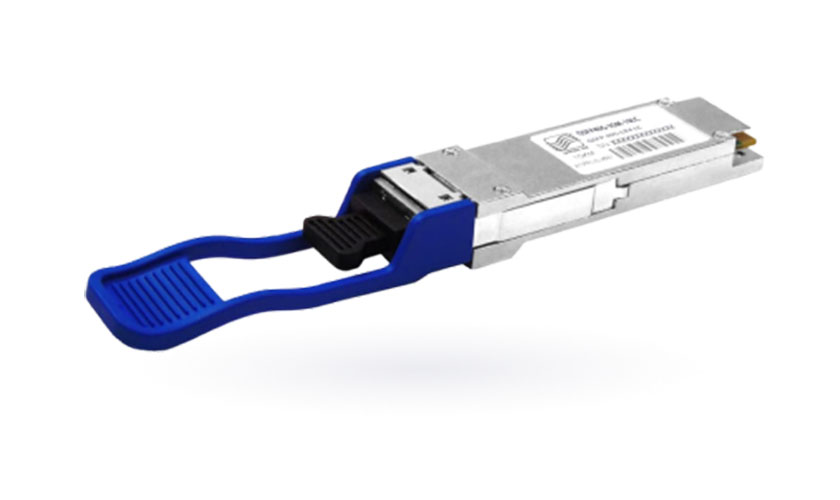
| QSFP28 | up to 100G | Most popular. Compact and cost-effective. |
| CFP2 | up to 200/400G | Larger. Often used in DWDM solutions by telecom operators. |
| QSFP-DD | up to 400G | Double-density pins. Supports both 100G and 400G. Backward compatible with QSFP28. |
| OSFP | up to 400G | Bulkier but offers better heat dissipation. Requires special slots. |
If you’re choosing a transceiver today, go for modern solutions with QSFP-DD support-they offer room for future upgrades.
Practical Tips: How to Avoid Overpaying Without Losing Reliability
Our specialists recommend the following:
- Measure the distance between nodes. Buy optical transceivers based on actual conditions. Never “overspec” just in case.
- Consider the speed: If 100G meets your data needs, there’s no point in jumping to 400G.
- Plan your budget: Include the cost of the transceiver, cooling, fiber cable, and power consumption.
- Account for future scaling: Expansion may be needed. Opt for QSFP-DD or OSFP to stay upgrade-ready.
- Check compatibility and certifications, especially if you’re using third-party modules.
- Evaluate technical specs carefully. Don’t overspend on high-speed models unless your infrastructure truly requires them-but don’t cut corners either if your 100G system is already underperforming.
Base your choice on real-world requirements, and always factor in the current infrastructure and its potential for growth.