
 18.06.2025
 5306
5306 When designing or launching a fiber-optic line, several key parameters must be considered: signal power level, line losses, and the optical budget. These values help determine whether the signal will reach the end receiver with sufficient quality. Let’s explore how the optical budget is calculated, its purpose, and how it works.
What is an Optical Budget
The optical budget refers to the maximum allowable signal loss between the transmitter and receiver in a fiber-optic link. It is calculated as the difference between the transmitter’s output power and the receiver’s sensitivity. If actual losses exceed this threshold, the link will not function.
Total losses include:
cable attenuation (typically 0.25 to 0.5 dB/km);
connector losses (around 0.3-0.5 dB per connector);
splice losses (on average 0.1 dB per splice);
splitter losses (3-15 dB depending on the type);
degradation and unforeseen conditions margin (recommended 2-3 dB).
If total losses are less than the optical budget, the system will work. In some cases, additional equipment may be required, such as optical transceivers to extend transmission distance.

Optical Signal Power
Optical signal power is measured in dBm, a logarithmic unit that shows how much stronger or weaker the signal is compared to a 1 mW reference.
Typical values:
laser transmitter power: from -5 to +5 dBm;
receiver sensitivity: from -18 to -30 dBm;
optimal operating range: from -10 to -25 dBm (depending on the equipment).
Important! A signal that is too strong (typically above +3 dBm) can overload the optical receiver. Conversely, a signal that is too weak (below the sensitivity threshold) increases the risk of transmission errors and data loss.
Difference Between dB and dBm
Many confuse dB and dBm, leading to miscalculations and incorrect signal analysis. Understanding the distinction is essential:
dB (decibel) is a relative unit, used to compare two levels, such as gain or attenuation.
dBm (decibel-milliwatt) is an absolute unit, expressing power relative to 1 mW.
Examples:
0 dBm = 1 mW
+3 dBm ≈ 2 mW
-3 dBm ≈ 0.5 mW
Note: You cannot add dB and dBm directly-they represent different measurement types and must be used appropriately.
How to Measure Optical Signal
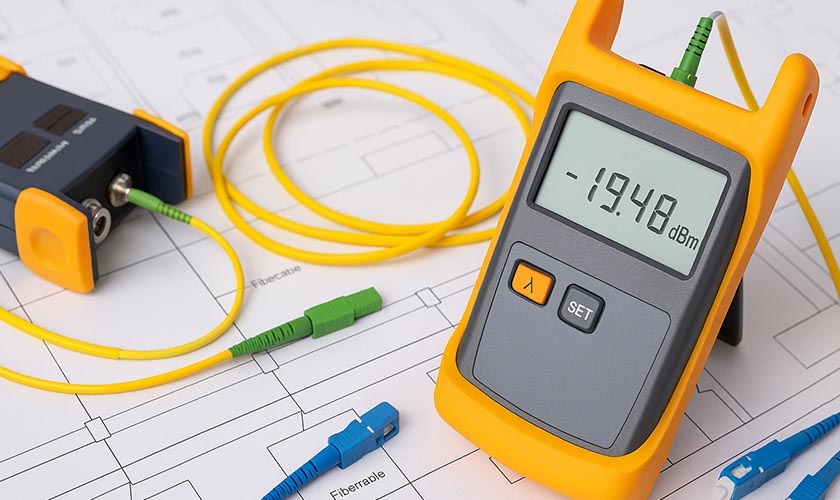
To measure signal levels in fiber-optic systems, the following equipment is commonly used:
optical multimeter – measures line attenuation in dB; includes both light source and meter in one device;
power meter – measures actual signal power at the receiver side in dBm;
optical Time-Domain Reflectometer (OTDR) – plots the entire line, showing breaks, splices, reflections, and connectors.
Measurements are typically performed at operating wavelengths such as 1310 nm, 1490 nm, or 1550 nm.
Optical Budget Calculation
Accurate optical budget calculation is critical for reliable system performance.
Formula:
Optical Budget (dB) = Transmitter Power (dBm) – Receiver Sensitivity (dBm)
This value indicates the maximum allowable signal loss on the line.
Example:
If the transmitter outputs +2 dBm and the receiver sensitivity is -20 dBm, then:
+2 dBm – (-20 dBm) = 22 dB – this is the available optical budget.
Now calculate total line loss using:
Cable attenuation = cable length × rated loss (e.g., 0.35 dB/km)
Connector losses = 0.3-0.5 dB per connector
Splice losses = ~0.05-0.1 dB per splice
Splitter losses = 3-18 dB depending on type
Reliability margin = 2-3 dB for aging, dirt, temperature changes
As a result, if the losses are lower – the line is operational, if they are close to the threshold – a margin is required, if the losses exceed the limit – it is necessary to shorten the distance or use DWDM equipment with higher power and sensitivity.
Conclusion
The optical budget is a crucial tool for engineers when designing fiber-optic links. It shows whether the signal has enough power to travel the entire path without exceeding allowable loss limits. dBm values reflect the real-world operating conditions.
A precise optical budget calculation is necessary during the design phase, before the system is commissioned. This helps identify potential issues early and avoid equipment failures. Accurate measurements and calculations are the foundation of stable connections. Underestimating parameters can lead to signal loss, transmission errors, and expensive rework.