
 13.03.2025
 3097
3097 Without transceivers now it is difficult to imagine high-speed and uninterrupted transmission of information. They are used everywhere in telecommunication and computing systems. Many people call this device a kind of media converter, just more compact. Let’s find out what it is and why you need a transceiver.
What is an optical transceiver
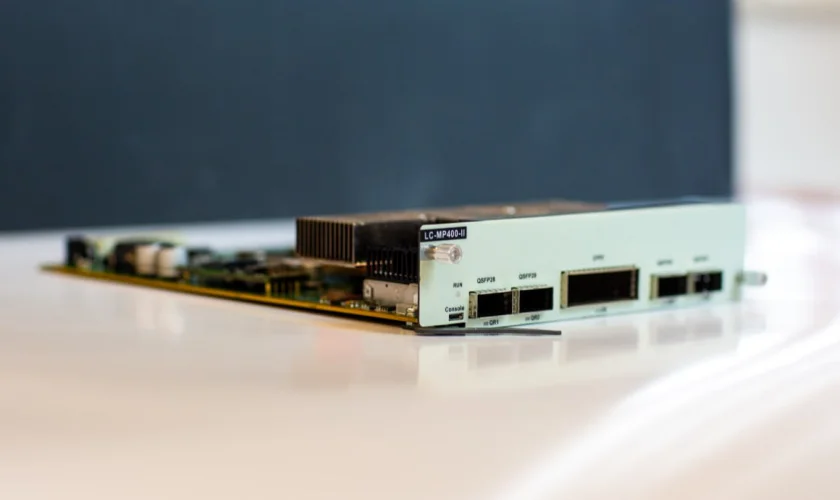
An optical transceiver is a compact device that combines transmitter and receiver options. Its main task is to convert signals from electrical to optical, transmit them, and then convert them back. This enables high-speed transmission of information over fibre optics with minimal or no signal loss.
What an optical transceiver is for
A transceiver is a mini-device that performs several tasks at once:
It supports protocols. The device can be used in Fibre Channel, SONET/SDH, Ethernet networks. This provides versatility and flexibility in building a network infrastructure.
Ensures compatibility. There are several standard form factors and protocols for these devices that support specific data rates and operate at specified wavelengths. This ensures compatibility between equipment from different manufacturers.
Converts signals. An optical transceiver receives the electrical signal that comes from the network equipment. It then converts it into an optical signal so that it can be transmitted over the optical fibre. Then, on the receiving end, this signal is converted into an electrical signal for further processing.
The use of an optical transceiver helps to reduce delays and losses when transmitting information over long distances. This is especially important in modern computing and telecommunication systems.

Optical transceiver design
The transceiver can be divided into two parts: a module for creating an optical signal and an electrical interface.
With the help of the former, an optical signal is created, which is later converted into an electrical signal. All this happens under the influence of a light source. It can be laser or LED.
The second part is used to provide a stable connection to network equipment. This allows you to transmit signals between different devices, as well as to control the operation of the first part of the transceiver.
Types and types of optical transceivers
There are several varieties of optical transceivers. They all differ in their form factor, protocol, speed and transmission range.
| Form factor | Brief description | Throughput | Operating range | Connectors |
| SFP (Small Form-factor Pluggable) | The most common type. You can equip switches or multiplexers with several dozens of ports | up to 4.25 Gbit/s | up to 80 km | RJ45, SC, LC |
| SFP+ | Externally does not differ from the previous variant. The only difference is in the technical characteristics | up to 10 Gbit/s | up to 120 km | RJ45, SC, LC |
| XFP (10 Gigabit Small Form-factor Pluggable) | Works in SDH, WDM, Gigabit Ethernet equipment | up to 10 Gbit/s | up to 120 km | LC |
| X2 | Scope of application – CWDM/DWDM multiplexing systems | up to 10 Gbit/s | up to 40 km | LC |
| QSFP+ (Quad Small Form-factor Pluggable) | Supports dual fibre speeds when installed in a switch, router IP network. Remote performance monitoring is possible. | up to 40 Gbit/s | up to 40 km | RJ45, SC, LC |
| QSFP28 | Suitable for high-speed IP networks. | Up to 25 Gbps on each of 4 bandwidth channels | up to 40 km | RJ45, SC, LC |
| CFP (C Form-factor Pluggable) | Designed for high-speed data transmission | total bandwidth up to 100 Gbps | multimode – 150 metres, singlemode – up to 40 km | RJ45, SC, LC |
Operating principle of optical transceiver
Optical transceivers work according to the following principle:
- Transmit data. An electrical signal is sent from the network device to the transceiver’s transmitter. It is then converted into an optical signal by using a light source. This signal then travels along the optical fibre and arrives at the receiving end device.
- Receiving data. The optical signal arrives at the receiving end device, where it is converted into an electrical signal using a photodiode. The information is then processed by the network equipment.
This is most often seen in telecoms and computer networks, where data is transmitted quickly and over long distances.

How to choose the right optical transceivers
In order for your network to run smoothly and efficiently, you need to choose the right optical transceiver. To do this, you should consider several factors:
- Equipment compatibility. The transceiver should support the baud rate and form factor of your devices. You need to choose the model carefully because most networking devices still run on the Cisco SFP standard.
- Operating temperature. It is best to choose transceivers with the highest possible – industrial temperature range (-40°C to 85°C).
- Data rate. Each equipment has a specific data rate. For example, 1 Gbps, 10 Gbps, 25 Gbps. The transceiver must meet the performance requirements.
- Fibre type and transmission distance. There are single-mode fibre (SMF) and multi-mode fibre (MMF). The first is suitable for distances up to 120 km with a wavelength of approximately 1310-1550 nm. The second is less powerful: the maximum possible distance is up to 2 km and the wavelength is 850 nm.
- Additional options. Some equipment has a digital diagnostic monitoring (DDM) function. This allows you to monitor operating parameters in real time, making maintenance and diagnostics much easier.
If you are not sure about the choice of DWDM equipment, please contact our specialists – we will find the best option for you.