

 21.04.2025
 7392
7392 Modern telecommunications systems are increasingly switching to optical solutions because they offer high data‑transfer speeds, minimal signal loss, and overall ease of operation. One of the most in‑demand and promising technologies in this field is PON — Passive Optical Network. Its key advantages are energy efficiency, a straightforward architecture, and low maintenance costs, making it popular with providers worldwide.
Definition of PON Technology
A PON (Passive Optical Network) is a fiber‑optic network in which a single provider line is shared among multiple subscribers without active equipment on intermediate segments. Unlike traditional networks, PON requires no power supply for distribution nodes, making it more resilient, reliable, and cost‑effective.
PON fibre optic systems are represented by the following key components:
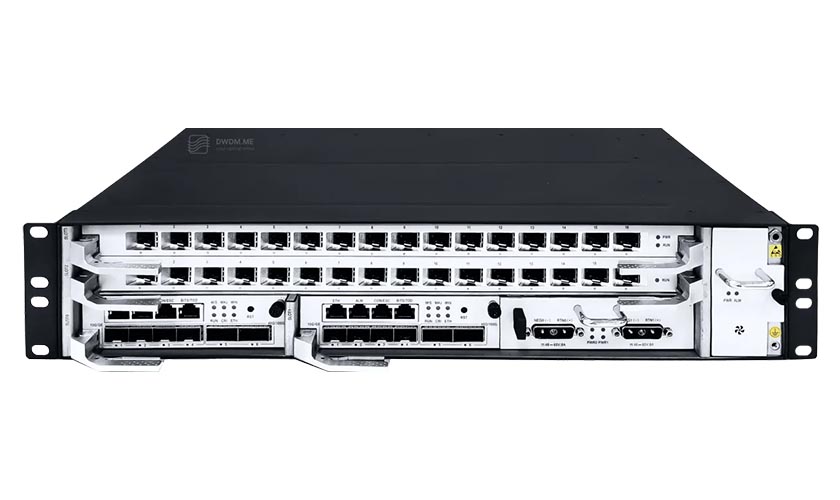
OLT (Optical Line Terminal) at the provider side;
ONT (Optical Network Terminal) at the subscriber side;
a passive optical distribution network.
PON supports bidirectional data transfer while achieving high bandwidth and minimal signal loss.
Where PON Technology Can Be Applied
Thanks to high data rates, energy efficiency, and the absence of active gear between node and subscriber, PON technologies are widely used across various domains. The simple architecture and easy maintenance make these networks relevant for both private and commercial projects, as well as public infrastructure.
Typical use cases include:
Internet access, telephony, and IPTV in multi‑dwelling residential buildings;
unified network infrastructures in office buildings and business centers;
centralized data delivery in hotels, medical, and educational facilities;
robust telecom infrastructure for industrial and logistics sites;
integration and management of all devices within a single network (IoT, metering systems, etc.);
combined security, communication, and data‑transfer systems at production enterprises.
PON is especially cost‑effective for long‑term infrastructure: it blends simplicity, reduced maintenance costs, and high technological capability. The network is easily scalable by installing higher‑capacity OLTs and adding new ONTs as needed.
Types of PON Networks
Several PON variants exist, chosen according to project goals and requirements:
- APON (ATM‑PON) — the first passive optical network version, ATM‑based; now rarely used.
- BPON (Broadband PON) — enhanced APON supporting broadband services.
- GPON (Gigabit PON) — one of the most popular options, providing downstream speeds up to 2.5 Gb/s.
- EPON (Ethernet PON) — Ethernet‑based, widely adopted in Asia.
- XG‑PON and XGS‑PON — advanced 10 Gb/s solutions for high‑capacity tasks.
- NG‑PON2 — next‑generation multi‑wavelength technology with flexible architecture and excellent scalability.
Each type has its own characteristics in data rate, architecture, and scalability, allowing the network to be adapted to diverse tasks and loads. Modern PON solutions suit both small projects and large infrastructures, enabling optimal choices based on traffic volume, subscriber count, and site specifics.
Advantages and Disadvantages of PON Technology
Key advantages:
no active components between provider and end user;
low operating and maintenance costs;
high data‑transfer speeds;
energy efficiency;
scalability and flexibility for network expansion.
Main limitations:
reach capped at about 20 km between OLT and ONT;
fault isolation can be challenging due to lack of active nodes;
limited users per line, typically no more than 64.

PON Connection Scheme
A PON connection follows this scheme: optical fiber runs from central equipment (OLT) to a splitter, which divides the signal into several streams. Each stream then feeds subscriber equipment such as ONT or ONU.
This simple, efficient setup is ideal when one cable serves dozens of users. The absence of intermediate active nodes minimizes breakdown risks and simplifies network maintenance.
How PON Technology Works
Network operation is based on separating upstream (subscriber → provider) and downstream (provider → subscriber) traffic. Data from the OLT reaches all ONTs, but each terminal reads only information intended for its subscriber.
Underlying the technology is multiplexing, which maximizes bandwidth utilization. Security is enhanced through encryption and time‑slot traffic separation.
Future Prospects of PON Technology
PON technologies are evolving rapidly: GPON, XG‑PON, and XGS‑PON standards with up to 10 Gb/s bandwidth are becoming mainstream. In parallel, NG‑PON2 is under active development, using multi‑channel approaches to deliver up to 40 Gb/s and support up to 128 subscribers per line.
As demand for broadband access grows—with more devices and cloud services—passive optical networks are shifting from merely important to indispensable infrastructure elements.