
 18.08.2025
 909
909 In today’s digital world, where data is the main business resource, ensuring fast and reliable exchange of information between data centers (data centers) becomes a critical task. Data Center Interconnect (DCI) is a technology that allows you to create high-speed and reliable connections between different data centers. It allows you to exchange data, computing resources and backup copies in real time. DCI is a key element of modern IT infrastructures, especially for large geographically distributed organizations, cloud providers and telecommunications companies that need to manage large volumes of data and ensure high availability of services. In addition, traffic growth caused by the rapid development of artificial intelligence systems, IoT (Internet of Things) and cloud computing makes DCI a necessary tool for scaling networks.
The DCU series platform, produced by the DWDM.ME company, is the optimal solution for DCI, combining compactness, high throughput, monitoring, control, reliability and energy efficiency. Platform updates include expanded monitoring capabilities, support for new standards and speeds that ensure adaptability to modern requirements. The platform is suitable for use in urban (Metro) and long-haul (Long Haul) networks, allowing to scale the infrastructure with minimal financial costs.
Therefore, we present the updated version of the DCU platform, and below we focus your attention on its technical characteristics and new features.
Brief technical characteristics of the DCU platform
The DCU platform provides bandwidth up to 96×200 Gbit/s or 60×400 Gbit/s, supporting linear speeds of 100 Gbit/s, 200 Gbit/s, 300 Gbit/s and 400 Gbit/s per DWDM channel. Each service slot of the chassis handles up to 800 Gbit/s. The modular design allows you to adapt the DCU system to specific tasks by selecting the necessary service cards.
How to effectively manage the platform
The platform is managed via CLI, SNMP and WEB interfaces with support for the YANG model for configuring automation. WSS cards provide up to 9-way routing. Double power supply unit (1+1 backup) with the option of choosing AC220V, HVDC or -48V. The power consumption does not exceed 1300 W.
The client side supports 10GE, 100GE, STM-x, 100G OTU4, 200GE and 400GE standards, ensuring compatibility with existing networks. Updated functionality includes advanced OSNR monitoring, DDM and real-time web monitoring, which simplifies network diagnostics and optimization.
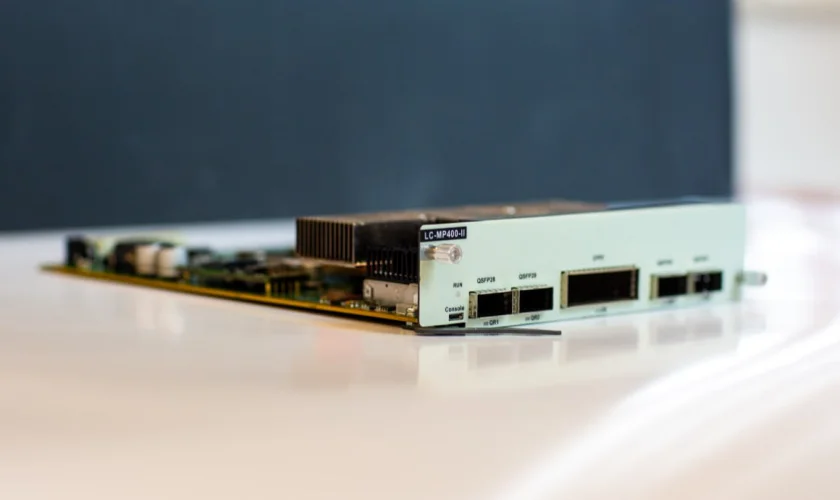
DCU muxponder service boards
DCU series muxponder service boards are intended for conversion of signals from switches/routers into xWDM signals for long-distance transmission. Updates in service boards of muxponders primarily concerned FlexE and LLDP support, which made it possible to improve network management.
200G LCD-200QS muxponder board: the client side supports 2×100 Gbit/s, 100 Gbit/s + 10×10 Gbit/s or 20×10 Gbit/s interfaces, linear – 1×200 Gbit/s. The 10 Gbit/s ports are compatible with 10GE, OTU2, STM-64, 10GE WAN, 100GE, 100GE FlexE and 100G OTU4 standards. The board provides OSNR monitoring, real-time monitoring, and supports the LLDP protocol to increase device visibility. The power consumption is up to 80 W, which ensures energy efficiency.
200G LCD-200Q2 muxponder card: the card supports 2×100 Gbps on the client side with support for 100GE, 100GE FlexE and 100G OTU4 standards. This board, with updated functionality, provides Ethernet RMON, DDM, OSNR and web monitoring in real time, and also supports LLDP. The power consumption is up to 100 W, which allows you to use it in energy-limited environments.
800G LCD-800Q4 muxponder card: the client side supports 4×200 Gbit/s or 4×100 Gbit/s, the line side supports 2×200 Gbit/s or 2×400 Gbit/s. The card provides transmission of single-channel signals at a speed of 200 or 400 Gbit/s (support of 100GE, 100GE FlexE, OTU4 and 400GE standards). The adjustable output power of the DCO module, as well as DDM, OSNR monitoring and web monitoring are added to the 800G LCD-800Q4 muxponder board. The power consumption is up to 100 W.
Optical backbone organization maps of the DCU platform
Optical highway organization cards in the DCU series platform are used for amplification, monitoring and protection of optical lines, ensuring communication stability.
The two-way linear amplifier LCD-OLA25 supports built-in OSC monitoring channels, adjustable gain through VOA and the MON interface, which allows you to adjust the signal parameters for long stretches.
LCD-OAU bidirectional end station amplifier includes functions such as OSC, VOA, MON, EDFA with output power of 23 dBm or 21 dBm, as well as OCM monitoring, which reduces signal loss la, when using the equipment in city networks. LCD-OAU has an updated system that improves monitoring accuracy.
Two-channel optical switch LCD-OLP provides line protection according to the 1+1 scheme, with the possibility of switching in manual or automatic modes, as well as detection of power losses without blocking the signal, which is especially critical for high-speed networks.

Additional service cards
Additional service cards (cards) in the DCU platform include:
LCD-OTDR: a board for monitoring an optical cable at a wavelength of 1625 nm with pulses from 5 ns to 20 μs – used for online monitoring;
LCD-9W25: an optical cross-connector with PA/BA/OSC and support for arbitrary increase/decrease of the wavelength for 9 different directions, which makes it possible to make the network more flexible when solving different tasks;
LCD-8 OPCM: monitoring board with 8 ports for real-time monitoring of 96 channels.
Advantages of implementing the DCU platform
Among the advantages of the DCU platform that are worth paying attention to, thanks to which it is worth using (or starting to implement) it in the network, the following can be distinguished:
the DCU platform has a modular chassis to save space and high bandwidth (up to 800 Gbit/s per slot);
convenient management via CLI, SNMP, WEB and YANG;
thanks to two power units, the power supply is organized according to the 1+1 scheme;
real-time monitoring (OSNR, DDM, RMON) simplifies network diagnostics by service technicians.
In addition, the consumed power of up to 1300 W allows you to significantly reduce energy consumption. Using the DCU platform in the network allows you to reduce operating costs.
The DCU platform is ideally suited for the organization of inter-datacenter connections in urban networks, providing fast data exchange, for example, for financial institutions or electronic commerce enterprises. In the networks of territorially distributed enterprises, where it is important to ensure low latency during data exchange or access to cloud resources (for example, AWS or Azure), the use of the DCU platform allows you to ensure the reservation and high availability of critical applications.
It is worth noting that the DCU platform reduces the total cost of ownership (TCO) of the equipment and significantly simplifies the integration and scaling of the network, thanks to the modular architecture and automated management system.
In summary, the key aspects of the DCU platform update can be highlighted, which include:
improved monitoring – OSNR, DDM, Ethernet RMON and real-time web monitoring functions for service cards have been added;
organized support for new standards and expanded support for FlexE and LLDP to improve network monitoring and management;
adjustable power – the ability to adjust the output power of the DCO module on the LCD-800Q4 board has been added;
optimization for Metro networks has been made – the accuracy of OCM monitoring on the LCD-OAU service card has been improved to reduce signal loss.
Updates made to both the DCU platform and its individual components make it more adaptable to the requirements of modern high-speed networks. The DCU platform provides effective connection of data processing centers, combining high performance, reliability and flexibility. It supports modern standards, simplifies network management and optimizes costs, which makes it suitable for organizations with territorially distributed infrastructure or companies seeking to scale their IT infrastructure.