
Transition from 100G to 200G/400G Without Full Equipment Replacement: Opportunities and Technical Solutions
 12.06.2025
 1090
1090 Increasing bandwidth is now a necessity, driven by the growing complexity of network services and consistent traffic growth. This compels operators and enterprise networks to move toward 200G or 400G solutions. However, such transitions often involve significant expenses.
This article outlines how to upgrade while preserving existing infrastructure, focusing on compatibility with passive optical components and the implementation of Super Channels.
Step-by-Step Modernization: Key Solutions and Approaches
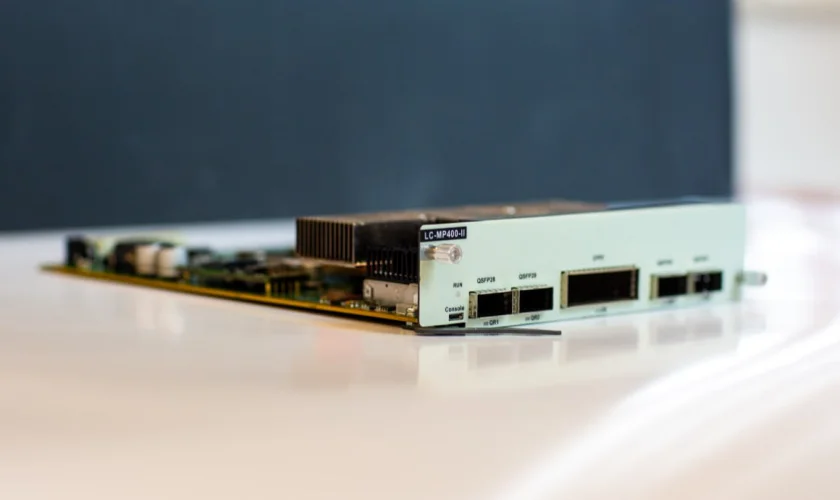
Modern equipment is typically based on modular architecture, supporting software-defined features and increased bandwidth without requiring a full replacement of chassis or optical line systems. Often, it’s enough to install new components – such as optical transceivers or line cards.
Common upgrade paths include:
Replacing QSFP28 (100G) transceivers with higher-speed alternatives like QSFP56 or QSFP-DD (200G/400G). Only pre-connected ports on routers and switches are required.
Using platforms compatible with QSFP28, QSFP-DD, and OSFP form factors to ensure faster adaptation to upgrades.
For instance, DWDM.ME offers a range of modules with QSFP28 interfaces that support a seamless transition to 200G and 400G through multi-channel aggregation technologies like Super Channels. The optical system remains unchanged while channel speeds increase.
Some devices also support software upgrades that unlock higher-speed interfaces, making modernization easier and faster.

Compatibility with Existing Passive Optics and MUX/DEMUX
Switching to 200G or 400G does not require laying new optical fiber. Instead, consider the following:
- Fiber type. Modular transceivers operate with single-mode fibers (SMF, ITU-T G.652), and are also compatible with ITU-T G.655 for long-distance transmission.
- Dispersion and attenuation. Fiber parameters must be managed to maintain signal quality over long distances.
Modern networks use CWDM/DWDM systems to transmit multiple signals over a single fiber. With technologies like Super Channels, even more data can be transmitted over one line, enabling speeds of 200G or 400G.
However, precise tuning of components, particularly signal-routing filters (MUX/DEMUX), may be required. In some cases, filters may need to be replaced or reconfigured.
To support flexibility and scalability, advanced technologies such as coherent optics and flex-grid channel spacing are implemented. These enhance fiber utilization and future-proof network infrastructure.
The most important aspect of a successful upgrade is stable interoperability between new and existing equipment. DWDM.ME devices are designed to align with current frequencies and channels, allowing the addition of high-speed links without touching the existing infrastructure – saving both time and money.
Using Super Channels
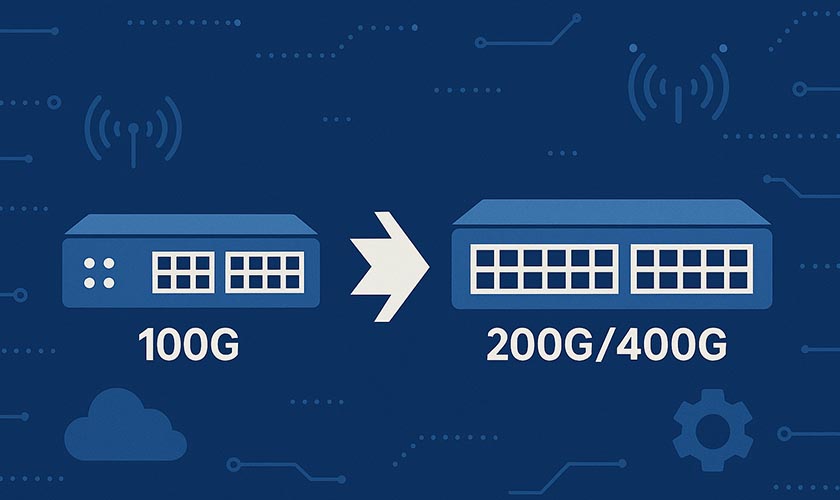
Super Channels combine multiple optical channels into one logical unit, significantly increasing bandwidth. For example, four 100G channels can be combined to form a 400G link, managed as a single data stream. This is enabled via muxponders and improves both scalability and flexibility.
Super Channels are commonly used by telecom operators for gradual bandwidth upgrades.
Benefits of Super Channels:
Higher spectral efficiency in DWDM systems;
Cost reduction;
Traffic consolidation and simplified network management;
Gradual, phased upgrades;
No need to replace the entire optical infrastructure.
Technical considerations:
Carefully verify compatibility with deployed DWDM systems;
All hardware must support Super Channel functionality;
Ensure stable signal quality through enhanced technical configurations.
You can upgrade to 200G or 400G without a complete overhaul – but it requires the right approach. Use solutions supporting modern transceiver form factors such as QSFP-DD and OSFP, and implement Super Channel technology. This will help increase bandwidth while minimizing costs.
Properly planned, phased modernization ensures network stability, cost efficiency, and scalability.